$400, $440 or $515 per tonne: how to compare EXW, FOB and DAP prices
13.11.2026
An EXW, FOB or DAP price covers a different share of the work. Here is how to bring three quotes to one point, and what to ask your supplier.
Three quotes for the same shipment: $400 per tonne EXW, $440 FOB and $515 DAP. The first looks like the clear winner, but each seller is promising a different amount of work. Bring all three to the same point, the buyer’s warehouse, and the ranking changes: EXW comes to $510, DAP to $515 and FOB to $518.
This follows on from the landed cost discussion in our 2027 margin guide for B2B traders. Here we work through how to make the comparison under Incoterms® 2020.
In short: before comparing prices, ask three questions.
- Where does the seller hand over the goods?
- Which costs are left to the buyer?
- At what point does the buyer take on the risk?
How to read a quote
The ICC’s Incoterms® rules divide duties, costs and risk between seller and buyer. They don’t cover payment terms or the moment title passes; the contract does. Paying in advance, for example, doesn’t mean the buyer already carries the transport risk (International Trade Administration).
Read a quote as a whole: price and unit + Incoterms rule + exact place or port + version of the rules. “DAP Warsaw” is too vague, because a terminal and the buyer’s own warehouse involve different handling and costs. ICC recommends naming the place as precisely as possible.
EXW: everything after the factory gate is on the buyer
EXW (Ex Works).
- Seller: makes the goods available at the agreed place, such as the producer’s warehouse.
- Buyer: loads, clears the goods for export, arranges transport and handles import.
- Risk passes when the goods are made available, before loading (ICC Academy on EXW and FCA).
A low EXW price means you have to price the whole chain from the handover point: loading, inland haulage, export formalities, freight and the costs at destination. The key question is export. Who can act as exporter or declarant under local rules? A foreign buyer can’t assume it is allowed to clear goods for export in every country.
What to do: before comparing prices, find out who can handle export clearance. If the seller loads the goods and clears export in practice anyway, ask for FCA at the seller’s premises.
FCA (Free Carrier): the seller clears the goods for export and hands them to the buyer’s carrier at the agreed place. It works for any mode of transport.
FOB: the price covers delivery on board the vessel
FOB (Free on Board).
- Seller: places the goods on board the vessel at the port of shipment and clears them for export.
- Buyer: books the freight and handles everything after that, including import.
- Risk passes once the goods are on board (FOB rules).
On top of the FOB price, add freight, handling at the destination port, import clearance, duties and taxes, and delivery from the port. Ask for a breakdown of handling charges: what is in the price of the goods, what is in the carrier’s rate and what is billed separately. Otherwise it is easy to count one operation twice.
When FOB doesn’t fit. FOB applies only to sea and inland waterway transport. If the goods are handed to the carrier before they are loaded on board, at a container terminal for instance, ICC points to FCA. For overland shipments by rail or truck, use FCA, CPT or DAP.
This matters for commodities from Kazakhstan. In our piece on sunflower husk pellet exports, the average export value came out at about $54 per tonne. That most likely reflects a price at the plant or the border, not delivery to the buyer.
What to do: work out where the producer actually hands the cargo to the carrier, and only then choose the rule.
DAP: the seller delivers, the buyer clears import
DAP (Delivered at Place).
- Seller: arranges transport, clears export and delivers the goods to the agreed place, ready for unloading.
- Buyer: clears import, pays duties and taxes, and unloads unless unloading is included in the carriage.
- Risk passes at the destination, before unloading (ICC Academy on DAP and DDP).
A DAP price to the warehouse isn’t the full cost of receiving the goods. If the seller has already paid for unloading under its own carriage contract, it can’t charge the buyer for it again unless the parties agree otherwise. But included unloading doesn’t push the transfer of risk to after it (ICC).
If the goods have to arrive already unloaded, heavy equipment for example, consider DPU (how it differs from DAP). If the buyer fails to meet its import obligations, it may face extra costs and the risk of damage to the cargo before it reaches the warehouse.
What to do: confirm who pays for and arranges unloading and import. Agree the paperwork and the arrangement with the customs broker before dispatch.
DPU (Delivered at Place Unloaded): the seller delivers the goods to the agreed place and unloads them itself. Risk passes to the buyer after unloading.
Comparing all three at one point
First fix the same specification, quantity, packaging, currency, shipment window and payment terms. Then pick a common point, for example the buyer’s warehouse with the goods on the truck, ready to unload.
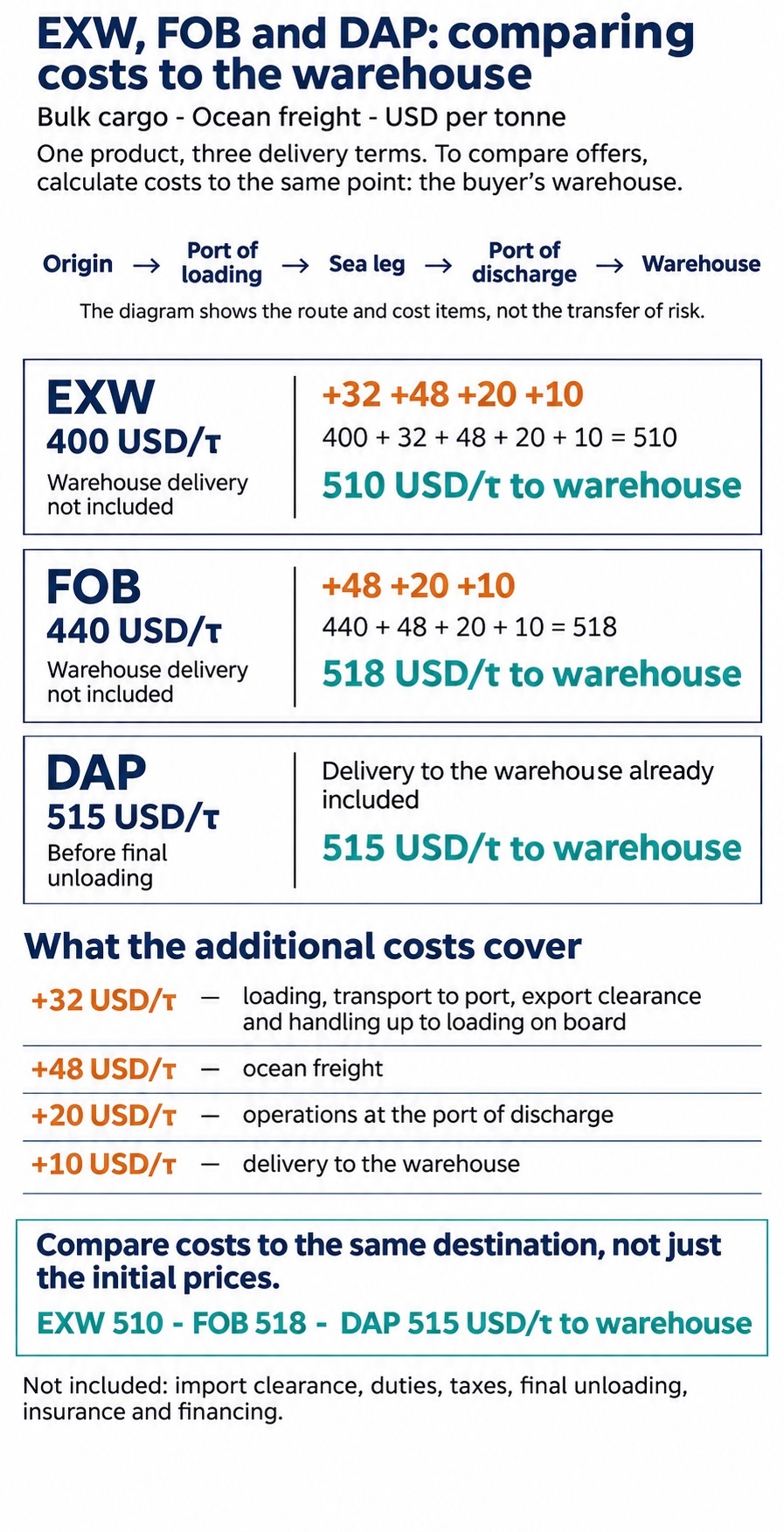
The result. On the original prices the order was 400, 440, 515. Once everything is brought to one point it becomes 510, 515, 518. The gap between EXW and DAP shrinks from $115 to $5 per tonne, and DAP turns out cheaper than FOB. EXW’s cushion is thin: if the buyer’s costs run $6 higher, EXW rises to $516 and DAP becomes the best option.
That doesn’t settle the choice of supplier, because the options differ in when risk passes and how much work falls on the buyer. Add the excluded items, and compare the load on working capital and the timing. Don’t assume import charges are equal either. For current rates and routes, see our overview of priority freight routes.
What else to look at
- Payment and delivery timing. The same price paid in advance or on credit ties up cash differently. A rough estimate: amount financed × annual cost of funding × number of days / 365. Also agree which event starts the clock: goods ready, goods loaded on board, or arrival at the DAP point.
- Insurance. EXW, FOB and DAP don’t require either party to insure the cargo (see sections A5/B5 of the rules for any mode of transport and for sea transport). Cover is a separate decision, and the seller’s liability and holding a policy are two different questions.
- Deviations from plan. Count delays as their own line: storage and container use, waiting for a vessel, time held at customs or at unloading. Put notification and cost-sharing in the contract, since naming the Incoterms rule doesn’t replace them (ICC).
What to ask the supplier
- The full rule wording: exact place or port, the agreed point and Incoterms® 2020.
- Specification and price unit: quality, quantity, net or gross, packaging, tolerances.
- Cost boundaries: what is included, what is excluded, how long the price is valid and when freight can be revised.
- Timing: the date goods are ready, shipped or delivered, and the event that proves it.
- Documents: who handles export and import clearance, and by when.
- Deviations: notices, recording of damage, payment for waiting time and how claims are made.
Match the answers to named parties: who books the transport, who checks the documents, who receives the cargo. It is at the join between contract and logistics that you see which costs are already covered and which are still assumptions.
How Oakmont Solutions helps compare quotes
We combine trade contract structuring with logistics, so we assess a quote along the whole chain, from the producer’s obligations to receipt of the goods.
- We bring supplier quotes to a single calculation point.
- We agree the Incoterms rule and the exact delivery place in the contract.
- We coordinate transport and documents.
What to send for a calculation: supplier quotes (rule and exact place), specification and volume, destination and preferred timing.
Want to compare quotes on full cost? Write to Oakmont Solutions and we’ll look at your case and propose a support model.
For information only. This article is not a substitute for legal and financial review of a contract, and the calculation in it is illustrative.
FAQ
What is the difference between EXW and FCA?
Under EXW the seller makes the goods available to the buyer and, by the standard allocation, neither loads them nor clears them for export. Under FCA at the seller’s premises, the seller loads the goods onto the buyer’s transport and clears them for export.
Is FOB suitable for a container, a rail wagon or a truck?
No. FOB is only for sea and inland waterway transport and assumes delivery on board the vessel. For a container handed over at a terminal, and for overland shipments, consider FCA, CPT or DAP.
Does DAP include unloading?
The seller isn’t obliged to unload. But if it has paid for unloading under its own carriage contract, it can’t charge the buyer again without a separate agreement. If the goods must be handed over already unloaded, consider DPU.
What is landed cost?
The full cost of getting the goods to the buyer’s warehouse: the goods themselves, transport, insurance, duties and fees, compliance, the cost of capital and a reserve for deviations. Suppliers should be compared on this figure.
