Priority Cargo Delivery Routes in November 2026
31.10.2026
Which route to choose from Asia in November: transit times, container freight rates and backup options
Oakmont Solutions · Logistics & Transport · Updated 11 November 2026 (first published 31 October 2026)
What changed since 31 October
- Suez Canal. Some container lines continue to move services back to the canal route. According to Drewry data for 5 November, about 60% of Asia–Europe capacity now passes through Suez. A week earlier, Alphaliner put the share at almost two thirds (AJOT).
- Rates. The increases that carriers planned for early November did not stick. Over the week, rates to North Europe fell by 5% (to about USD 3,400/FEU) and to the Mediterranean by 1% (to about USD 4,300/FEU). They remain above last year’s levels, by 50% and 88% respectively (Freightos, 10 November).
- Persian Gulf. Direct calls by container ships on some routes remain restricted. Cargo moves through ports on the Gulf of Oman coast with an overland leg: operator DP World has moved more than 1 million TEU through such corridors.
In brief: for planned Asia–Europe shipments, the best option in November is ocean freight via Suez on services that have already returned to this route. The November rate increases have not stuck so far, but rates remain above last year’s levels, so ask for an all-in quote. Urgent containers from China to Europe are better sent by rail via the Middle Corridor. For Persian Gulf countries, plan an overland leg. For the US, check tariff conditions and port operating status in advance.
Suez: container lines are returning to the canal route
CMA CGM, Maersk, Hapag-Lloyd, MSC and OOCL have moved part of their vessels back to the canal route, and COSCO has done so partially (Maritime Executive). The Premier Alliance (ONE, HMM and Yang Ming) has added its FE1 Asia–North Europe service via Suez, with bookings open from November.
A full return is not here yet. Linerlytica expects it in the first quarter of 2027. Drewry points to another factor: if the return is faster than expected, simultaneous vessel arrivals could cause congestion at European ports.
What this means for cargo owners:
- Suez saves on average 7–10 days compared with the route around Africa.
- Schedules are mixed: some sailings go through the Red Sea, others around the Cape of Good Hope. Confirm the routing when booking.
- If your cargo is on a service that has just switched back to Suez, allow a buffer for possible congestion at European ports.
- The route around the Cape of Good Hope remains a reliable backup for cargo with a fixed delivery date.
Container freight rates: down over the week on all main lanes
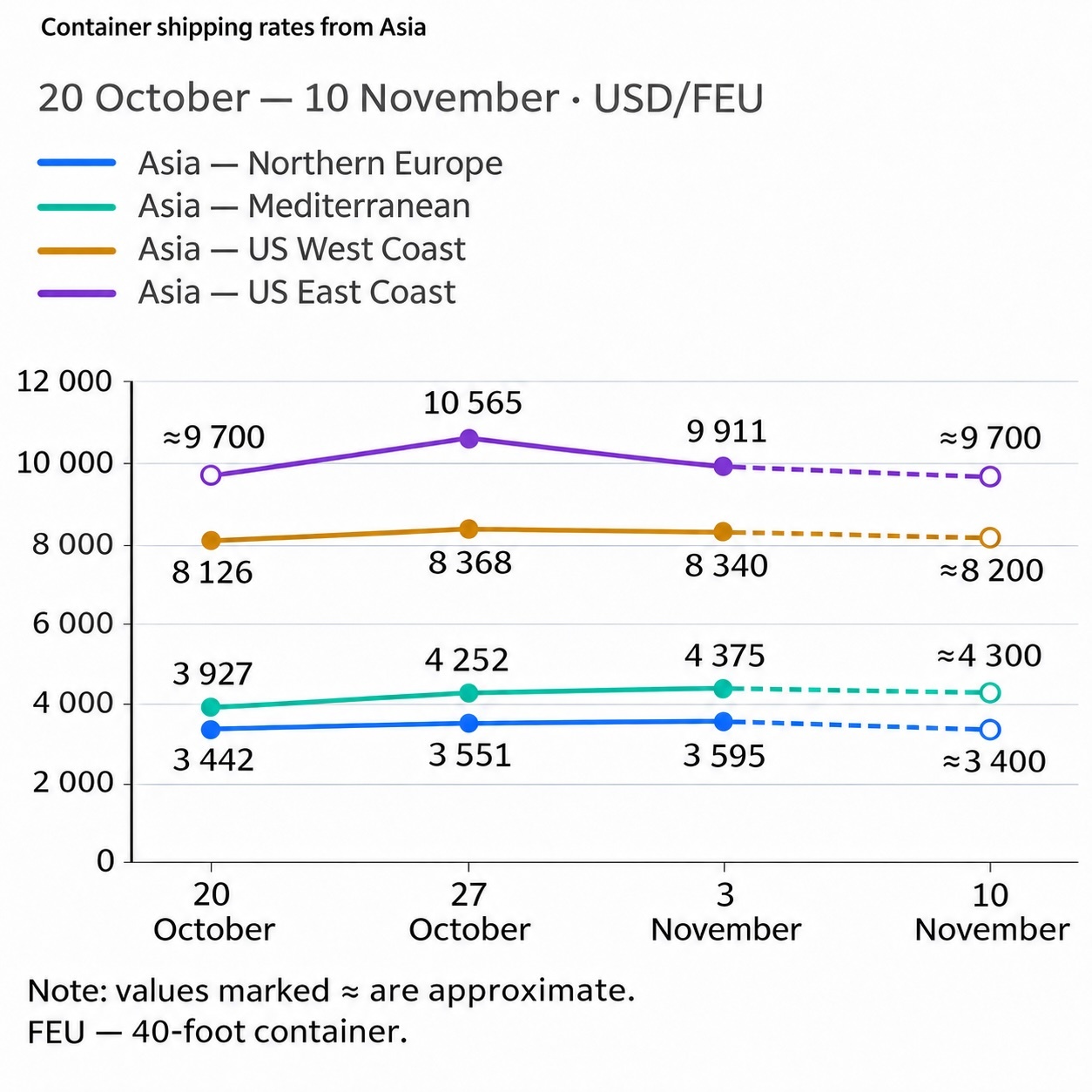
Over the period shown, spot rates to Northern Europe and the Mediterranean peaked on 3 November, while rates to both US coasts peaked on 27 October. By 10 November, rates to Northern Europe and the US East Coast were close to their 20 October levels. The Mediterranean rate was still about 10% higher than on 20 October.
Drewry’s World Container Index stood at USD 4,389 per 40ft container on 5 November, 1% lower than a week earlier. Shanghai–Rotterdam: USD 3,615 (−2%); Shanghai–Genoa: USD 4,166 (unchanged). Drewry updates the index on Thursdays; the next release is on 12 November.
Carriers had planned to raise Asia–Europe rates by USD 1,000–1,500 per FEU from the start of November and again in mid-month. Freightos reported on 10 November that the planned 1 November increase had not taken hold in Asia–Europe spot rates, which fell that week on both the Northern Europe and Mediterranean routes. Carriers’ published rates and index spot rates do not coincide: for example, MSC raised its published Far East–West Mediterranean rate from USD 5,000 to USD 5,300 for the second half of November (Container News). Spot, published and contract rates differ, so compare offers on the same terms and ask for all charges to be itemised.
China – Europe by rail: the Middle Corridor
For urgent shipments where ocean transit is too slow, the main option today is the Trans-Caspian route through Kazakhstan, the Caspian Sea, Azerbaijan, Georgia and Türkiye. According to Kazakhstan’s Ministry of Transport (5 October), transit time on the route has fallen from 38 to 13–17 days, and the digital module Tez Customs has cut transit clearance time from eight hours to 30 minutes.
These figures refer to a section of the route and come from the government side. For door-to-door planning, 20–30 days is more realistic: for example, ÖBB Rail Cargo Group quotes about 30 days, and the Caspian crossing and border delays can add up to a week. The Caspian section remains the bottleneck. Kazakhstan’s national rail operator plans to build its own maritime fleet to expand capacity, but this is so far a plan, not a change for November bookings.
Persian Gulf countries: plan the overland leg in advance
Direct calls by container ships at ports inside the Gulf remain restricted on some routes. The working scheme today is delivery by sea to ports on the Gulf of Oman coast (Fujairah, Khor Fakkan) and onward by land, including via customs corridors to Jebel Ali.
For cargo to the Gulf countries, plan an overland leg, prepare documents in advance and check the current status of the route before shipping: it changes.
Asia – US: what to consider
Rates. They remain close to peak levels: about USD 8,200/FEU to the West Coast and about USD 9,700/FEU to the East Coast (Freightos, 10 November). Demand is slowing: according to the US National Retail Federation, container imports in November will be 14% below the September peak. But do not rely on falling rates when planning.
Tariff conditions and port operations. Before booking, ask your forwarder about the duties and charges currently applicable to your HS code, and about the operating status of the ports you plan to use. Allow a time buffer in your schedule.
Panama Canal. From 15 October the canal opened a tenth daily slot in the Neopanamax locks, and total capacity returned to 33 transits per day. For fiscal year 2027 the canal plans an average of 29.5 transits per day because of the risk of a strong El Niño. For the US East Coast, keep a backup option: West Coast ports plus rail.
Which route to choose: November summary
Moving a project, not just a container
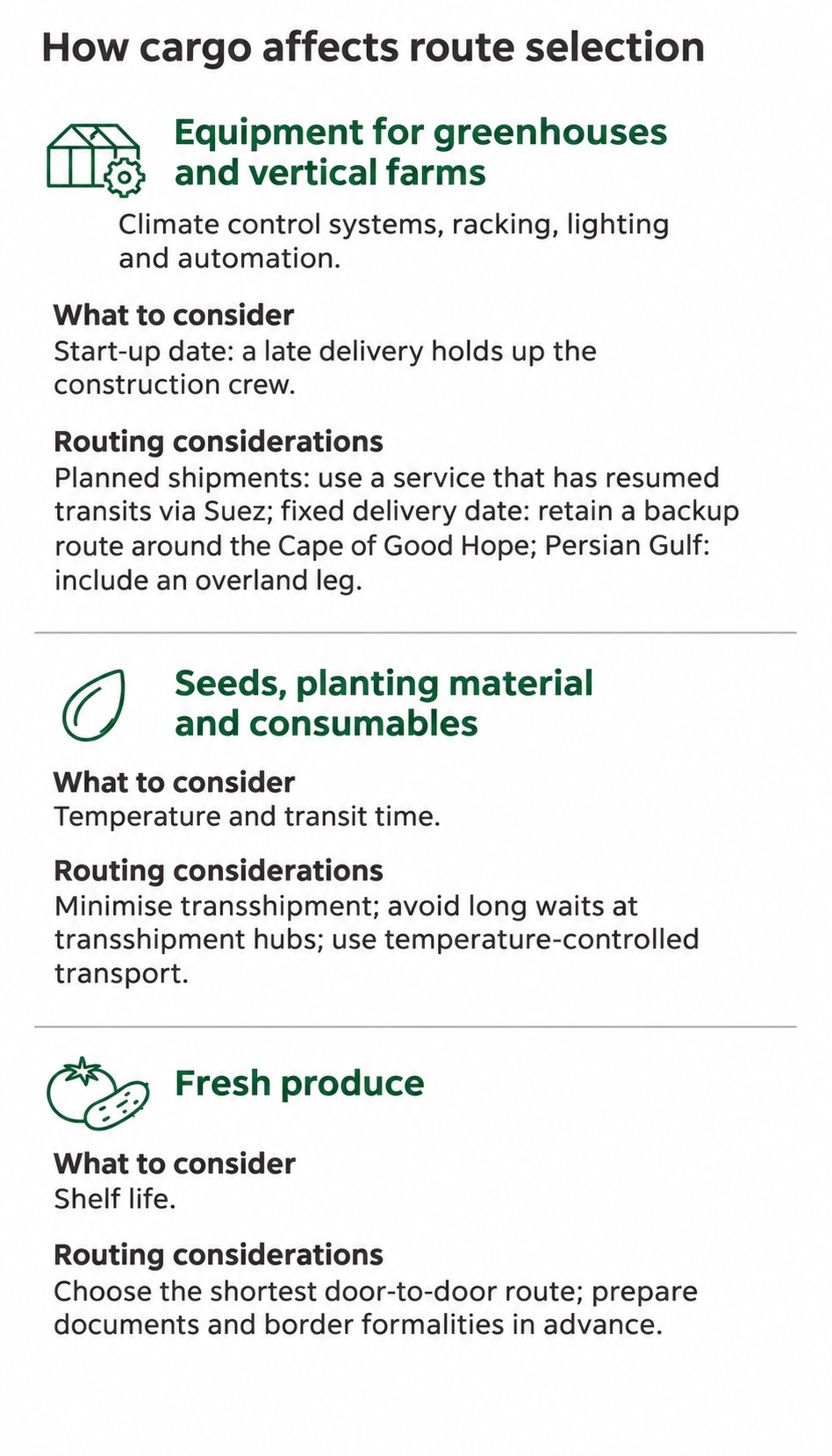
Logistics connects every link of the chain from land to market. In agricultural and greenhouse projects the cargo is more varied than a standard container of goods, and each type calls for its own route logic.
Checklist before you book
- Ask for the routing (Suez or Cape of Good Hope) in writing and find out what happens if the carrier changes it en route.
- Request an all-in quote with every charge listed, including seasonal and routing-related charges.
- Agree a backup route in advance for cargo with a fixed delivery date.
- For Gulf countries, confirm the overland leg and documents. For the US, check tariff conditions and port operating status.
- For perishable cargo, specify the temperature range and the maximum time at each handover.
How Oakmont Solutions helps you choose a route
We arrange shipments by road, sea and rail, including temperature-controlled cargo. We select a primary and a backup route for your cargo and delivery date, coordinate documents and monitor the key stages.
What to send for a quote: cargo type and weight, volume, origin and destination, the desired delivery date and, for perishable cargo, the temperature range.
This article is updated regularly: the date of the latest update is shown at the top of the page.
