Smart Farming: How Data Turns Every Field into a Better Bet
31.10.2026
Smart farming by Oakmont Solutions: from drone surveys to machinery track maps, all in one system
Smart farming in a nutshell
Smart farming (also called precision agriculture) means running a farm on evidence instead of gut feeling. Drone and satellite images, local weather data, readings from machinery and the full history of each plot tell you where to sow, feed and spray, and just as importantly, where not to. The payoff is lower spending on seed, fertilizer, fuel and labor, plus yields you can actually plan around.
Oakmont Solutions gives farms a complete Smart Farming system: aerial surveys and satellite monitoring, track maps for machinery, and one digital workspace where all the data comes together.
Why smart farming is becoming the new normal
Digital farming has moved well past the pilot stage. An international study led by the University of Bonn, published in PNAS in October 2026, found that smart farming technologies, from robots and drones to AI-based tools, already pay off on 42% of the world’s cropland. The authors expect that share to reach 50% within 20 years, and as much as 75% if environmental rules tighten everywhere.
The pattern behind the numbers is telling. Gains are biggest where fields are large, labor is expensive and fertilizer and pesticide use is heavy, which is exactly where applying inputs only when and where they’re needed saves the most. Smart irrigation, meanwhile, tends to pay for itself fastest in regions short on water.
Europe is building the supporting infrastructure, too. Wageningen University & Research in the Netherlands and its partners created SmartAgriHubs, a network of more than 140 digital innovation hubs where farmers, researchers, tech companies and regulators test solutions side by side. Around forty hands-on experiments have already taken digital tools into real fields. In the Baltic states, for example, growers use a Dutch precision-farming app for their potato crops.
The takeaway is simple: the farms that put data at the heart of field management today will have a head start tomorrow.
What’s inside Oakmont Solutions’ Smart Farming system
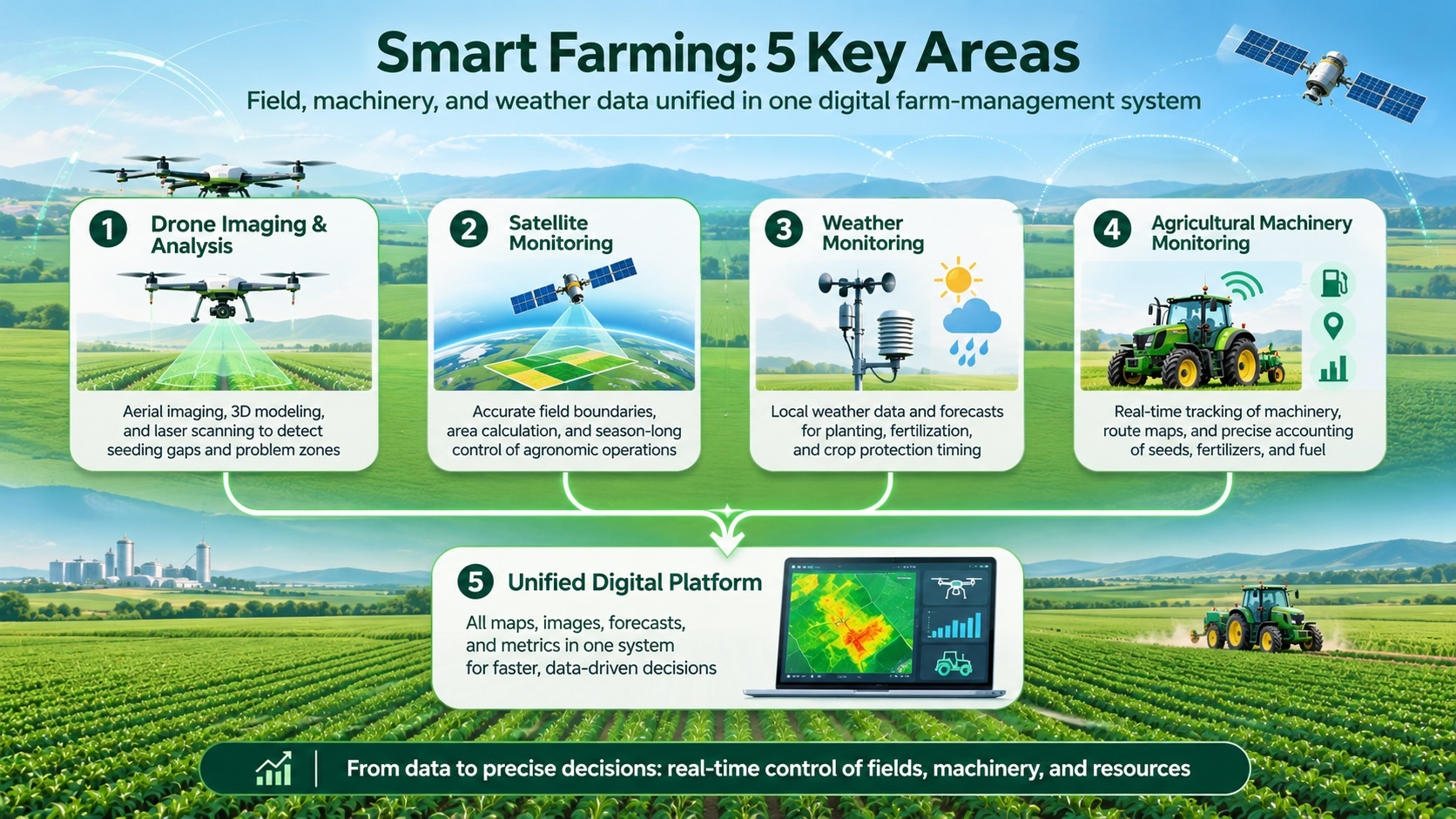
The system combines five building blocks. Each one is useful on its own; together they form a digital twin of your farm.
1. Drone surveys and analysis
Drones collect detailed data on your land: aerial photography, 3D modeling, laser scanning and detection of sowing defects. You see the uneven spots in a field, such as problem zones, gaps in emergence and patches of stressed plants, long before they’re obvious from the ground.
2. Satellite monitoring
Satellite data pins down the exact boundaries of fields and work areas and calculates their acreage. It also helps you plan and track agronomic operations through the season and from one year to the next.
3. Weather monitoring
Local weather data and forecasts guide the big timing calls: when to sow, when to fertilize, when to protect the crop. They feed into the rest of the system alongside every other indicator.
4. Machinery monitoring
See where your equipment is and what it’s doing in real time. The system builds track maps and records exactly how much seed, fertilizer and fuel went into each plot.
5. One digital platform
Maps, tracks, forecasts, imagery and indicators all live in a single system. Managers get an up-to-date picture of the whole farm without juggling spreadsheets or reconciling reports by hand.
How we work with your land
Every project starts with a study of your land resources. Here is what that covers:
- Link to the state land register. We compare the boundaries of actual land use with official registry data and track how those boundaries have changed over the years.
- Land-use breakdown. We determine the composition and area of each land-use type.
- Field zoning. Each field is split into zones with distinct characteristics (microzones), and zones are grouped by how intensively they can be farmed.
- Spatial history. You can see how every plot has changed from season to season.
- Remote crop assessment, including quick diagnostics of plant nitrogen status.
- Advisory support at every stage.
From data to decisions: agronomic planning
Once the data is in, Oakmont Solutions helps turn it into practical choices:
- which crops suit each plot best;
- which crop rotations make sense;
- in what order to improve and transform plots;
- how much fertilizer and soil amendment you need, and how to get it delivered;
- how to optimize farm layout, including roads, drainage canals, access routes and shelterbelts;
- which soil-protection measures keep your land at the agro-ecological condition you’re aiming for.
Track maps and variable-rate application: precision in every pass
One of our core services is programming soil operations. We build track maps for your machinery for every field operation, with the option of variable-rate application of soil amendments and fertilizers. The machine applies exactly what each microzone needs, no more and no less. That means fewer overlaps and skips, lower input use and real-time quality control over the work being done.
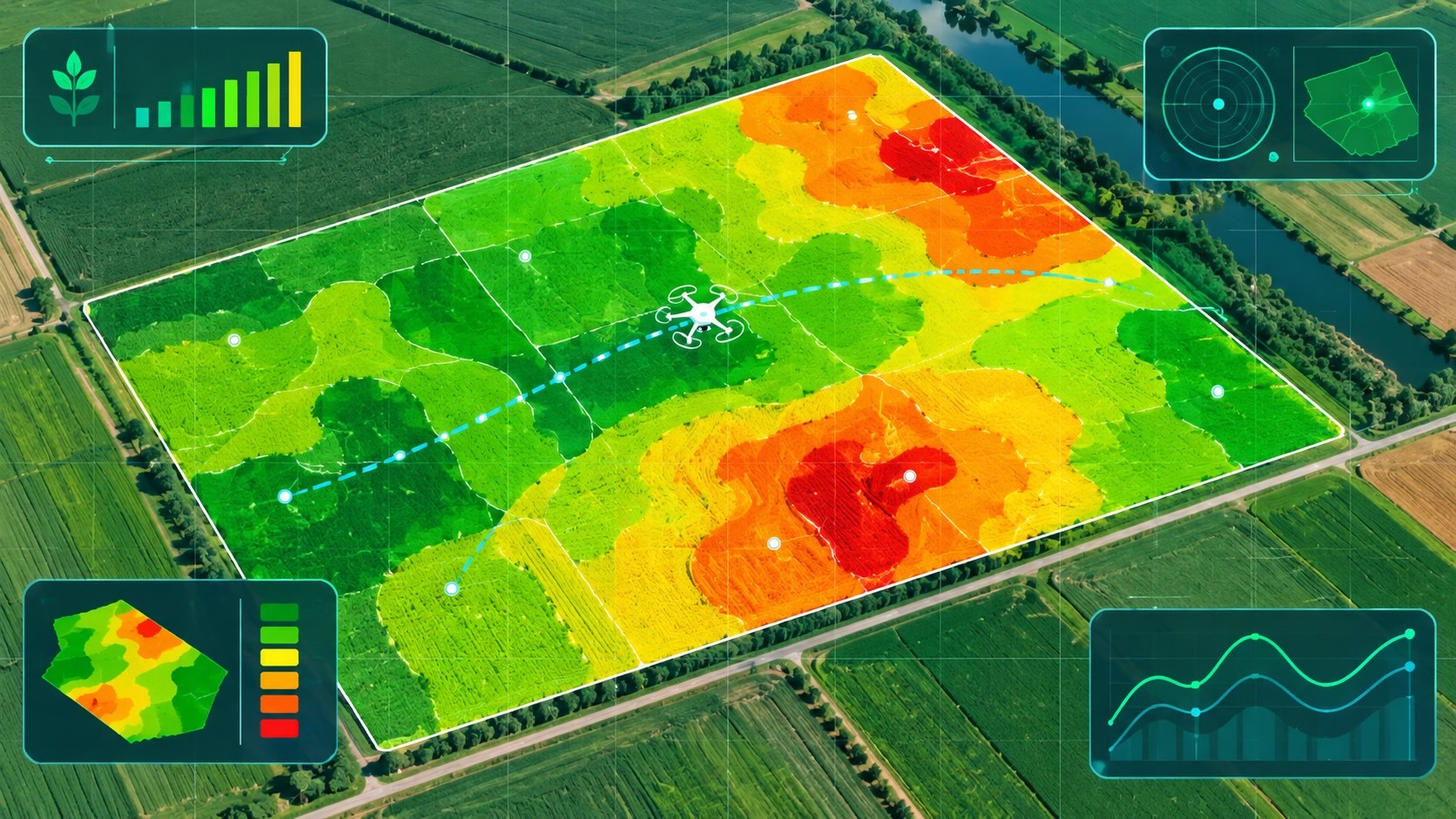
The technologies the University of Bonn researchers single out as the backbone of smart farming follow the same logic: drones and mapping systems, machines that calculate fertilizer and pesticide doses automatically, GPS guidance that keeps equipment on exact paths without overlap, autonomous irrigation and weeding robots.
Precision farming vs. the traditional approach
What your farm gets:
- Exact boundaries and agronomic condition of your land, and a way to refine its cadastral value.
- A data model of every plot, broken down by microzone.
- Up-to-date information on the state of your fields, any time.
- Yield forecasts for the main crops.
- The right crops and rotations for each plot.
- Savings on seed and fertilizer with precision-seeding machinery.
- Exact consumption figures logged by smart equipment.
- A lighter environmental footprint, since fertilizers and pesticides go only where needed.
- A clear read on soil condition after harvest.
- Steadier, higher yields and better quality, whatever the weather does.
- Lower energy, raw-material and input costs.
- Fewer working hours for staff and machines.
- A lower cost per unit of output.
Put simply, precision farming helps a farm business trim its fixed costs and raise its profit.
Your data should work for you
Going digital raises a fair question about trust: who owns a farm’s data, and who benefits from it? Researchers at Wageningen stress the need for secure, transparent sharing of data on harvests, crops, climate and markets, in a way that benefits everyone along the chain. We see it the same way. Your farm’s data is your asset, and our job is to turn it into decisions that pay off.
Why Oakmont Solutions
Oakmont Solutions sits where international B2B trade, logistics and biotechnology meet. We are part of UNEX Group, whose story began in 1996, and our projects span more than 10 countries. Our experience includes managing the creation and operation of innovative greenhouse complexes (an EPCM contract for fifth-generation greenhouses) and introducing innovative feeds and biotechnology in crop production. That lets us treat smart farming as one link in a longer chain, from the field and biotech all the way to logistics and delivery.
Frequently asked questions
What is smart farming, in plain words?
It’s farming guided by data. Drone and satellite images, weather information and machine readings help you fertilize, sow and till only where and when it’s truly needed.
How is smart farming different from precision farming?
In practice, people often use the two terms interchangeably. “Precision farming” puts the spotlight on treating zones and doses differently within a field. “Smart farming” is broader: it also covers AI, automation, IoT sensors and unified digital platforms.
Does smart farming pay off?
According to the University of Bonn–led study (PNAS, 2026), it already does on 42% of the world’s cropland. The effect is stronger on large fields, where labor is costly and a lot of fertilizer and pesticide goes on. For your own farm, we calculate the payback once we’ve analyzed your plots.
Is the system suitable for small and mid-sized farms?
Yes. You can pick services one module at a time, for instance starting with satellite monitoring and boundary verification, then adding drone surveys and track maps. The researchers do point out that many technologies were developed with large operations in mind, so it matters to choose solutions that fit your scale.
What do I need to get started?
Get in touch and tell us about your farm: where it is, how big it is, what you grow and what you’re trying to solve. We’ll analyze your land resources and propose an implementation plan.
Can the system be integrated with state land register data?
Yes. It compares the boundaries of actual land use with registry data and shows how they’ve changed over the years.
Request a consultation
Want to see how smart farming could change the economics of your farm? Leave a request on oakmont-solutions.com or message us on Telegram or WhatsApp. Our specialists will run an initial analysis of your land and suggest a solution built around your goals.
