Methane-Reducing Feed Additives for Cattle: Cut Emissions and Improve Feed Conversion
04.11.2026
What the 2026 research really shows on 3-NOP, nitrate and bromoform, and where the data ends and manufacturers’ claims begin
The short version. Methane from ruminants is both a climate problem and a leak of feed energy. The 2026 numbers: a meta-analysis of 17 studies found that 3-NOP cut methane by about 36% on average in beef cattle; nitrate trims roughly 20% in dairy herds; and a bromoform-based additive reached up to 80% in the manufacturer’s own trials. But not every additive improves performance, independent long-term data is thin, and, according to a 2026 review, carbon markets don’t yet cover the full cost. Below: what’s confirmed, what companies merely claim, and where the risks lie.
Why cattle methane is a business issue, not just an environmental one
When rumen microbes break down fiber, they release hydrogen and other by-products. Methanogenic archaea use that hydrogen to make methane, which the animal mostly releases when it belches. For a producer, this isn’t abstract: part of the feed’s energy escapes into the air instead of turning into meat or milk.
Investors and processors care for a different reason. Retailers and food companies are setting climate targets across their supply chains (Scope 3), and raw-material suppliers increasingly have to prove they have cut emissions. That puts additives that reduce methane and pay for themselves at the crossroads of animal nutrition, finance and trade.
What the latest research shows
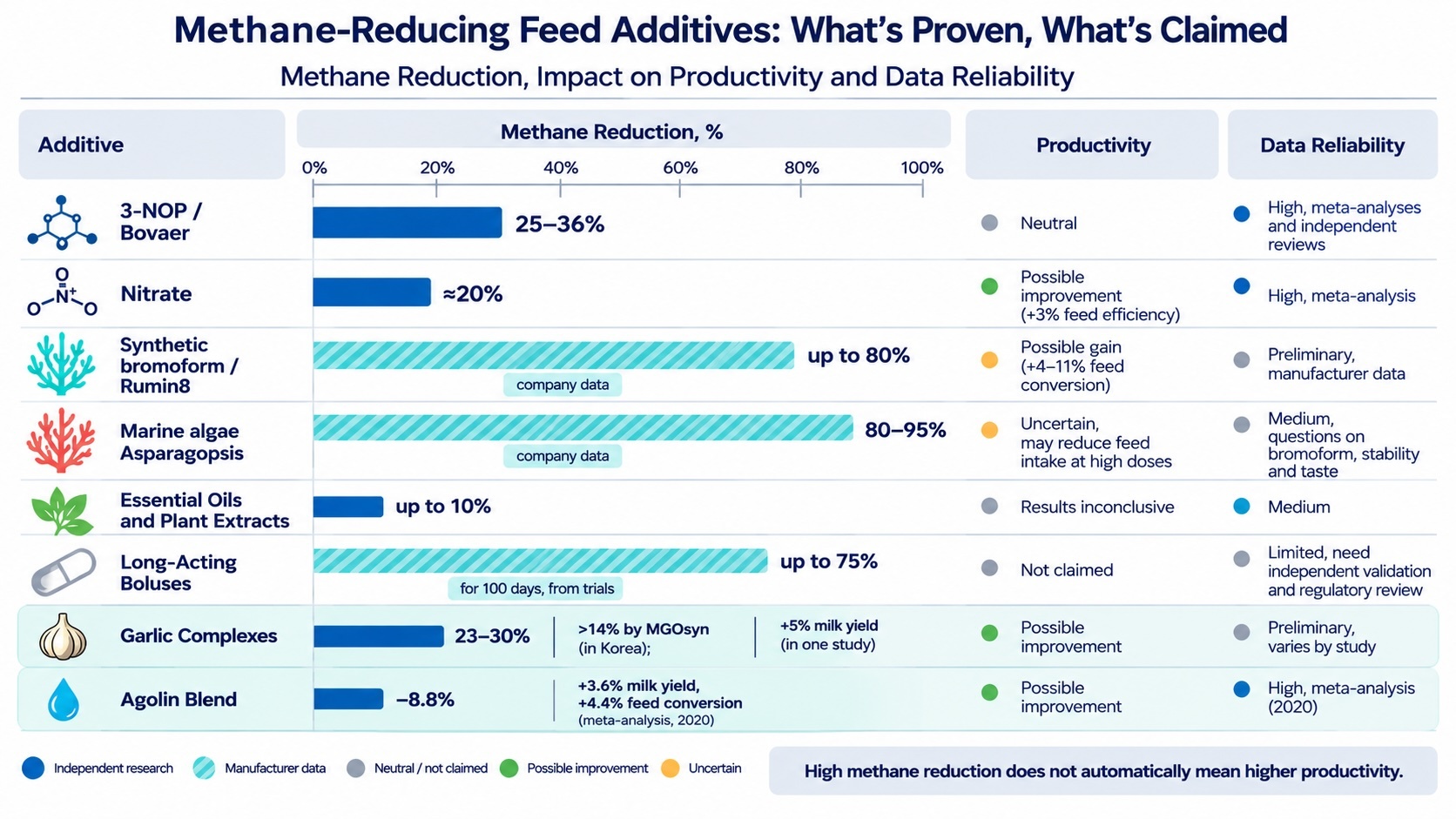
What are 3-NOP and Bovaer? 3-NOP (3-nitrooxypropanol) is the active ingredient that dsm-firmenich sells under the brand name Bovaer. It inhibits the enzyme methanogenic archaea rely on to produce methane in the rumen. Most of the numbers below relate to it, so we start there.
Beef cattle. A March 2026 meta-analysis in animal (17 studies) found that 3-NOP cut methane production by 36.2% on average and methane yield by 33.2%. Results varied widely (a standard deviation of about 24 percentage points). The effect was stronger in finishing cattle, weakened as dietary fiber rose, and leveled off at doses above roughly 200 mg/kg of dry matter. One author works for dsm-firmenich, the maker of 3-NOP (a conflict of interest disclosed in the paper). Trials ran from 3 to 34 weeks, so the long-term effect remains an open question.
Dairy cattle. A mini-review in Frontiers in Microbiology (April 2026) calls 3-NOP the most effective approved additive for dairy cattle (a 25-30% reduction) and notes that combinations of additives haven’t yet been proven in large herds. For nitrate, a Journal of Dairy Science meta-analysis (March 2026, 10 studies) found methane down by about 20%, but with lower feed intake (around 0.8 kg a day) and lower milk protein. Feed efficiency rose about 3% and milk yield stayed flat, because cows simply ate less. The authors work for Cargill, which sells a nitrate-based additive.
Next-generation additives. According to Rumin8 (July 2026), its pelleted additive based on synthetic bromoform cuts methane by about 80% and improves feed conversion in beef cattle by 4.1-10.7%. Commercial launch is planned for late 2027 in Brazil, with US and European entry taking another 2-3 years. In three US trials, feed conversion beat the control by 4.1%, 8.3% and 10.7%, and in the first trial methane fell by 81%. These are preliminary results from a company press release. The CEO said early results were inconsistent, which the company blames on the instability of its first, oil-based formulation. The pellets proved steadier, and another trial in more than 1,000 animals is planned before launch.
Lessons from Asia. In South Korea, MGOsyn, a supplement built on monolaurin, garlic and oregano, cut methane in Hanwoo bulls by more than 14% on average, above the national 10% threshold for certifying low-methane feeds. The maker is still preparing its certification application.
Rollout and safety in practice. Denmark now requires methane cuts through the diet, and about 1,400 of its roughly 2,000 dairy farms began feeding Bovaer (a 3-NOP-based additive) in October 2025. Some farmers reported health problems in their herds, and the Danish Veterinary and Food Administration commissioned a study from Aarhus University. According to a dsm-firmenich release (May 2026), an analysis of 73 dairy herds found no causal link. We have only seen the manufacturer’s summary, so the original report is worth checking. In Scotland, a 2026 census found that only 6 of 6,416 holdings (about 0.1%) used Bovaer; the statistics don’t say why.
Comparing the options: which additive to choose
Two things to keep in mind: figures marked as company data haven’t been independently verified, and a big methane cut doesn’t automatically mean more meat or milk.
Does cutting methane mean better feed conversion?
Methane represents a loss of 3-10% of gross feed energy, but blocking it doesn’t automatically yield more meat or milk. When methane formation is suppressed, hydrogen builds up, and unless it is redirected into useful pathways, there’s no payoff. That’s why, according to the 2026 review, current additives don’t always raise productivity and run into regulatory and economic barriers.
The practical takeaway: if methane is your only goal, pick an additive with proven reductions. If you also want better feed conversion, demand trial data from conditions close to yours. With nitrate, the efficiency gain comes from lower feed intake and costs you milk protein, while Rumin8’s data is still preliminary and comes from the company itself. Diet matters too: in the beef meta-analysis, the effect of 3-NOP fell as dietary fiber rose, and fat and starch content were significant factors in one of the models. So choose the additive together with the ration.
Where rumen-protected feeds fit in
Methane-focused additives solve one problem. The other is making sure the energy and protein in the ration actually reach the animal. That’s the idea behind our work on rumen-protected starch, proteins and fats for cattle (more on our biotechnology for livestock page). In the sources we reviewed, we found no direct data on how protected nutrients affect methane, so we make no such claims. The logic of combining them is clear, though: an inhibitor reduces methane losses, while protected feeds raise the share of nutrients absorbed in the intestine. Whether the combination works in your system has to be confirmed by your own trial.
A practical plan for farmers
- Identify your production system. Feedlots and dairy farms using a total mixed ration (TMR) are the easiest case. Efficacy estimates assume good mixing and steady intake, which is harder to ensure on pasture; boluses are being developed for grazing systems.
- Check registration. The additive must be approved in your country. Approval timelines vary, and new products often wait years.
- Run the numbers per head. Rumin8 puts the benefit at up to $137 per animal a year at US prices at the time, or about $46 for a 110-day finishing program (company estimate). For dairy cows, Elanco said in 2024 that carbon markets and government support could add $20 or more per cow (manufacturer’s estimate). According to the 2026 review, current carbon schemes are unlikely to cover the full cost, and the EU emissions trading system barely touches agriculture.
- Ask for the trial protocols. Look at the duration (more than six months is needed to check rumen adaptation), herd size, diet type, independent publications, and the authors’ ties to the manufacturer.
- Start with a pilot. Set aside a group of animals and compare it with a control on weight gain, feed conversion, milk yield and rumen health.
What partners and investors should weigh
- Regulatory timelines. Many products already work in Latin America, but entry into the US and EU takes longer. Ruminant BioTech expected its first approvals in New Zealand in early 2026 and is targeting Canada, Brazil and the EU; check the current status.
- Returns depend on carbon markets and programs. Measurement and verification costs limit participation, and payouts lag adoption. An additive should pay for itself even without credits.
- Data quality. The boldest numbers come from the developers. Peer-reviewed meta-analyses are more conservative, and authors of key papers have ties to manufacturers.
- Reputation and acceptance. The Bovaer story is a cautionary tale: Arla’s pilot with retailers triggered online protests, and after it ended in November 2025, Arla reviewed the results before deciding on further use. The technology needs transparent communication.
- This is not investment advice. The material is for information only; manufacturers’ figures don’t guarantee results on your farm or in your project.
What this means for B2B supply
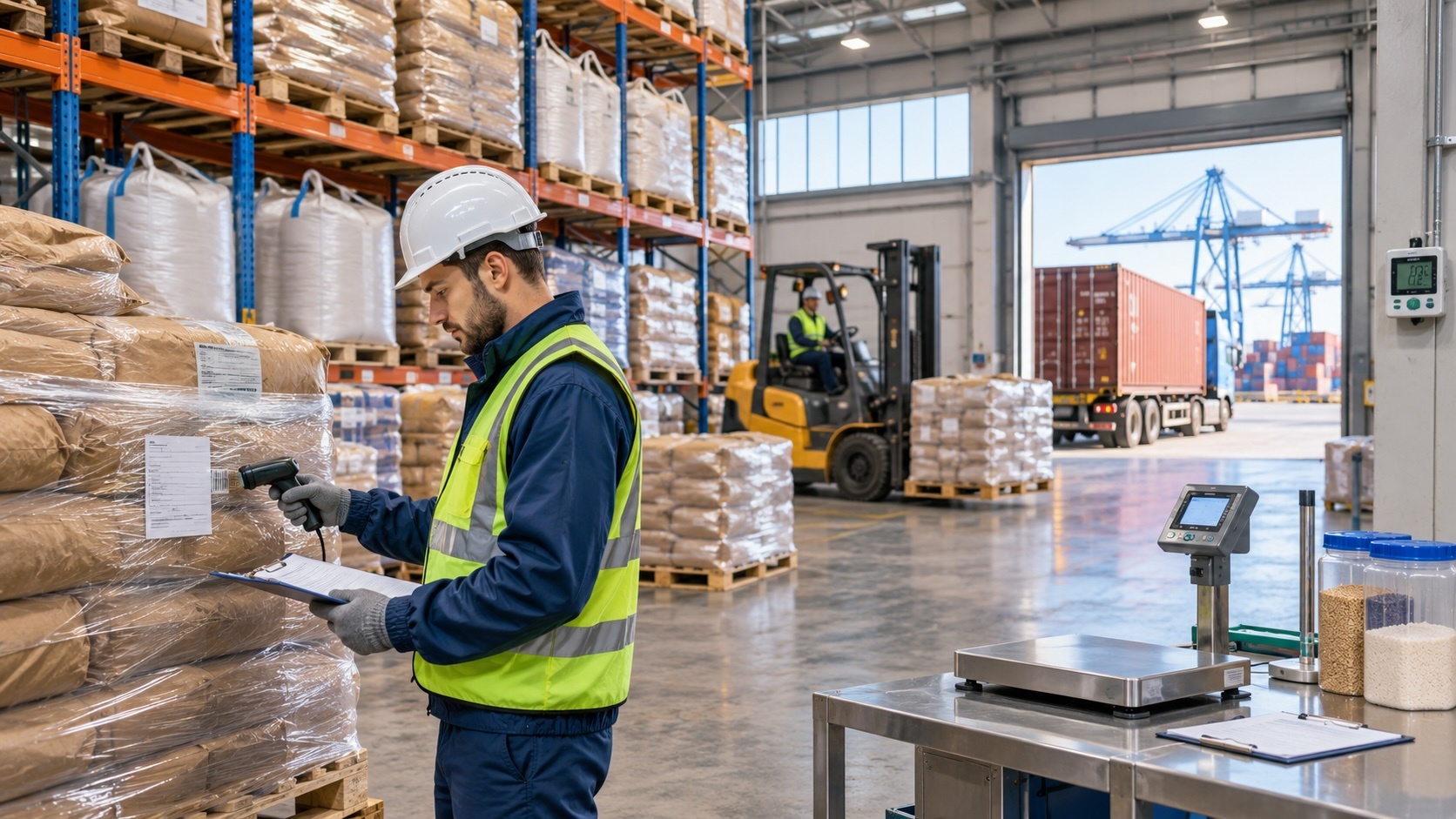
The market for feed additives and feeds is globalizing fast: production, registration and consumption happen in different countries. For importers, that means paperwork, temperature control and delivery schedules. At Oakmont Solutions, we support such deals as part of our international B2B trade services and arrange logistics by land, sea and rail. We covered how traders can protect their margin in such projects in a separate article. Follow industry updates in our News section.
Frequently asked questions
How much do feed additives reduce methane in cattle? It depends on the compound and the diet. For 3-NOP, a 2026 meta-analysis in beef cattle found an average cut of about 36% with wide variation, while a review puts dairy herds at 25-30%. Nitrate delivers about 20% in dairy herds. Bromoform-based additives show up to 80% in the manufacturer’s trials, but that is still the company’s own data.
Do methane-reducing additives improve productivity? Not all of them. 3-NOP shows no consistent productivity gain. With nitrate, feed efficiency rises about 3% because cows eat less, but milk protein drops. For bromoform, the manufacturer reports a 4-11% improvement in feed conversion in beef cattle, but the data is preliminary.
Are methane-reducing feed additives safe? Approved additives go through regulatory review: the FDA completed its review of Bovaer for lactating cows in May 2024, and it is approved in the EU. In Denmark in 2025, some farmers reported animal health problems; according to the manufacturer’s summary, an Aarhus University study of 73 herds found no causal link. Check registration in your own country.
Can you make money by cutting methane? Possibly, through carbon credits and retailer programs, but a 2026 review judges that current carbon schemes are unlikely to cover the full cost. Manufacturers’ calculations, such as up to $137 per animal per year from Rumin8, remain the companies’ own estimates.
The bottom line
Methane-reducing feed additives have moved beyond the pilot stage, but the right choice depends on your goal. Meta-analyses confirm a meaningful, though not unlimited, reduction (about a third for 3-NOP, about a fifth for nitrate), while the higher figures for newer bromoform-based additives still rest on manufacturers’ data. Make the decision after a pilot on your own herd, a registration check and an honest cost calculation that allows for the uncertainty of carbon markets.
Planning a feed, additive or livestock supply project? Contact the Oakmont Solutions team: we’ll advise on products, paperwork and logistics.
